Small Business, Big Target: 5 Cyber Threats You Can’t Afford to Ignore
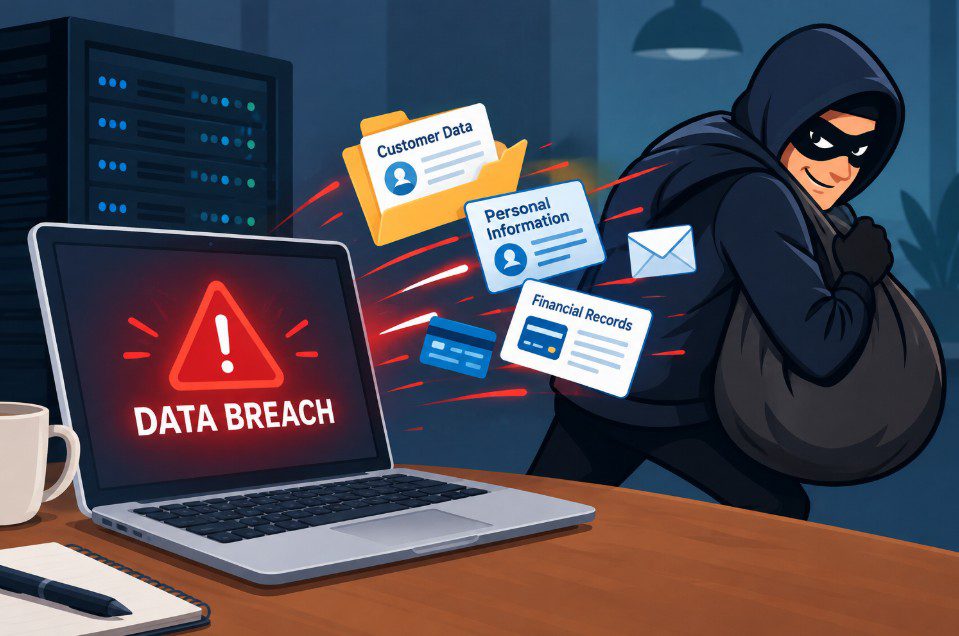
It’s not bad luck. Attackers go after small businesses because they’re easier to breach and slower to recover — and AI has only widened that gap.
1 in 323
emails sent to small businesses is a targeted attack — the highest rate of any company size
95%
of breaches trace back to a human decision, not a technical flaw
Writing a convincing scam email used to take time, money, fluency, and a bit of skill. AI has made it nearly free, which is why small businesses, the ones least likely to have a security team reading every email, are now catching the brunt of it. Here are the five threats doing the most damage right now, and the one habit that helps stop each of them.
1. Phishing
Phishing is still the front door for most attacks, and it’s gotten harder to spot. The typos and stiff wording that used to give a scam away are disappearing — AI-written lures now get clicked at roughly four times the rate of the old, human-written kind. One convincing email is often all it takes to get a foothold inside a business.
The one habit that helps…
Treat every unexpected request — an invoice, a password reset, a link from “IT” — as unverified until you confirm it through a second channel. A phone call beats a reply every time.
2. Ransomware
Ransomware shows up in 88% of small-business breaches, compared with under 40% at large companies. Bigger organizations can often isolate an outbreak and keep operating; a 20-person business rarely has that slack, which is exactly why attackers view small businesses as easier, faster payouts.
The one habit that helps…
Store a copy of your critical files somewhere an attacker can’t reach — disconnected, or immutable — and actually practice restoring from it. A backup nobody has tested is just a guess about whether it works.
3. Business email compromise
No malware, no malicious link — just a well-timed email that looks like it’s from your vendor, your bank, or your own CEO, asking for a wire transfer or a change to payment details. It works because it exploits something every business already relies on: trusting the inbox to authorize money moving.
The one habit that helps…
Require a phone confirmation for any new or changed banking details — no exceptions, even when the request appears to come from leadership.
4. Credential theft
Stolen usernames and passwords account for roughly one in five breaches, and once an attacker is logging in with real credentials, they look like a normal employee. That’s a big part of why the typical breach goes unnoticed for months rather than days.
The one habit that helps…
Turn on multi-factor authentication everywhere it’s offered. It’s still one of the cheapest, highest-return controls a small business can put in place.
5. Supply chain attacks
Your business is only as secure as the least secure vendor you connect to. Breaches involving a third party doubled year over year, and small businesses often sit inside the supply chain of much larger companies — making them a convenient side door for attackers aiming higher.
The one habit that helps stop these attacks…
Before connecting any vendor’s software or account to your systems, ask what security practices they follow — and revisit that list once a year, not once ever.
None of this requires an enterprise budget
The small businesses that hold up aren’t the ones spending the most — they’re the ones that made these five habits non-negotiable: verify before you click, back up before you need to, confirm payment changes by phone, turn on MFA everywhere, and vet vendors before connecting to them.
Your turn — which of these five has already shown up at your business? Reply or share this with the person who handles your invoices.
Have questions about where your business stands? Reach out to the 2Bware team
Sources
https://www.ic3.gov/AnnualReport/Reports/2025_IC3Report.pdf
https://www.verizon.com/business/resources/infographics/2025-dbir-smb-snapshot.pdf
https://www.insureon.com/blog/small-business-cyber-insurance-trends